Monday, September 6, 2010
AWOL - Ancient World Online
For those of you who haven't found Charles E. Jones' wonderful site which lists open-access journals, his blog today with links to scholars' archives in institutional respositories is timely.


Tuesday, August 31, 2010
Cleaning the Siq al Barid, Petra, Jordan
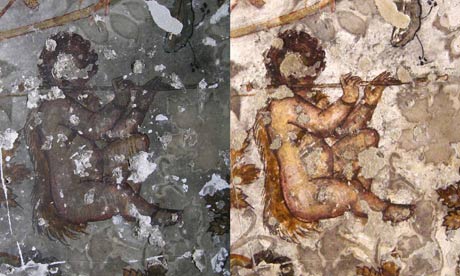
(from the Guardian article: Detail of a winged child playing the flute, before and after cleaning. Photograph: Courtesy of the Courtauld Institute)
I haven't been to the Siq al Barid in quite a few years, but will make an effort now the paintings have been cleaned by the Courtauld, for the Petra National Trust:
http://www.guardian.co.uk/science/2010/aug/22/hellenistic-wall-paintings-petra
Friday, June 4, 2010
Tax Collectors through Roman Eyes
There is a nasty stoush on at the moment in Australia between the Government which wants to impose a minerals tax on super-profits (and other measures) and the Mining Industry which claims that the sky will fall in if this happens. There is nothing new under the sun I discovered when reading this very enjoyable paper recently. I put here a long excerpt:
O. van Nijf, “The Social World of Tax Farmers and their Personnel”, The Customs Law of Asia, M. Cottier, M.H. Crawford, C.V. Crowther, J.-L. Ferrary, B.M. Levick, O. Salomies, M. Wörrle (eds), Oxford University Press, 2008, 279-311:281-284
“Busybodies search out these very matters and others still worse, not to cure but merely to expose them. For this reason, we are annoyed and displeased with customs officials, not when they pick up those articles that we are importing openly, but when in the search for concealed goods they pry into baggage and merchandise which are another’s property. And yet the law allows them to do this.”
The idea that members of the lower classes, even if they were special officials called scrutatores, [4] were rummaging through one’s possessions was clearly too much. The educated traveller may well have turned to the dictionary of Pollux to find a convenient list of words to abuse a tax farmer if he went too far: [5]
“Should you want to abuse a tax farmer, you might try saying: burden, pack animal, garotter, sneak-thief, shark, hurricane, oppressor of the down-trodden, inhuman, nail in my coffin, insatiable, immoderate, Shylock, violator, strangler, crusher, highwayman, strip-Jack-naked, snatcher, thief, overcharger, reckless, shameless, unblushing, pain in the neck, savage, wild, inhospitable, brute, dead weight, obstacle, heart of stone, flotsam, pariah, and all the other vile terms you can find to apply to someone’s character …”
Or praise him, when the man showed proper respect:
“Should you want to praise a tax farmer, you might say: law-abiding, hospitable, just, not overstepping the law, not over-zealous, better than life, knowing your place, palliator of the journey’s discomfort, someone you might want to interrupt your journey for; sweet harbour.”
The concern with the right vocabulary, and the choice of words, convey a distinct upper-class perspective: to the readers of Pollux, a good tax farmer was someone who know his place.
… a variant of this view stresses the morally suspect character of the tax collector by putting them on a par with pimps and procurers. The association must have been effective. Dio Chrysostom raises the issue in a dialogue about freedom: [8]
“Well then, do you think that it is permitted to you to do all things, which, while they are not forbidden by the laws yet are regarded as base and unseemly by mankind? I mean for example collecting taxes, or keeping a brothel, or doing other such things.”
Other sources agree: Artemidorus calls tax collecting an “unblushing profession”, which could signify prostitution, when it appears in a dream.[9] The emperor Julian also classes together people of the baser sort: “tax collectors, dancers and adulterers”. [10]
… A papyrus from the Zeno archive shows that the association was not always imaginary. The text mentions a pair of crooks who dealt in female prostitutes. They had kidnapped a girl, provided her with an outfit, and handed her over to a customs official who was to act as her pimp – the rationale apparently being that there would be frequent traffic, and plenty of customers. [12]
… Plutarch, though hardly a spokesman for the working classes, exposes the hypocrisy of the upper classes in this respect: [16]
“And they think it is a disgrace to be a tax collector, which the law allows; but they themselves lend money contrary to law, collecting taxes from their debtors, or rather, if the truth is to be told, cheating them in the act of lending.”"
[2] As it is clear from [Quint.] 341. 6, which defends the customs duties by pointing out that they paid i.a. for the army and for festivals
[3] Plut. De curios (
[4] scrutators: AE 1899, 180, 1933, 160; 1974, 485 …
[5] Pol. Omon. 9.30f.
[8] Dio Chrys. 14.14
[9] Art. Oneir. 4.42
[10] Julian, Adv. Gal. 283E
[12] PSI 4, 406, cf Pomeroy 1984, 163.
[16] Plut. De vitando aere alieno [829 C 9]
Subscribe to:
Posts (Atom)